

When I arrived in Maine to view the house I’d found while sifting through properties on the Internet, I already knew it came with a good sized yard. That was the most important piece of criteria outside of being able to walk to town. I wanted enough of a yard to plant a good sized vegetable garden. The idea of an enclosed garden with raised beds, and perhaps an arch with a gate to give it a bit of old fashioned charm appealed to me. Years of flipping through the pages of Fine Gardening, Sunset, and Martha Stewart’s Living made just as much an impact as living in a house for nearly 20 years which had little or no yard at all. Surely .41 acre would be enough, wouldn’t it?
-
I Began with the Guest Room
I’ve lived in many houses in my life, but never an old house — that is, unless one considers the house we owned before the last, built in 1948, old. I’ve always been drawn to old houses and old places. Perhaps for someone who has moved often in her life, the seeming permanence of a structure that has long stood in one place is the curiosity. I think of the stories it could tell if someone cared enough to listen.
-

When Pigs Fly
Early in January two years ago, I thought — no, believed that before the year had drawn to a close, we would be well on our way to living life much differently from what we were familiar with. Although daunting, nothing could cloud the excitement of moving to another country. I’d lived in Spain as a child, and so the idea was a familiar one. With enough research and careful planning, it seemed as if anything was possible. When the time was right, I believed pigs truly could fly. Since then, I’ve learned that not only can they fly, but in ways completely unexpected
(more…) -

2020: Glancing back, gazing ahead
On New Year’s Eve at the dawn of the last decade, I was fairly miserable. Not by the “foreign power laying siege to my homeland” standard, or the “bank repossessing my house on Christmas Eve” standard. The “finding out I have a catastrophic disease” standard also did not compare, because I know people who have heard that news and seen the effect it has had on their lives. I have to make the distinction because qualifying my unhappiness by comparing it to that of others is part of who I am. The guilt that surrounds whatever feelings of dissatisfaction I may have with certain life circumstances is palpable regardless of what those more knowledgeable of the human psyche have said. “There is no hierarchy of suffering,” states Dr. Edith Eva Eger, holocaust survivor and author of The Choice: Embrace the Possible. “There’s nothing that makes my pain worse or better than yours, no graph on which we can plot the relative importance of one sorrow versus another.” Still, I tend to measure, and that’s what I was doing ten years ago. Telling myself I had nothing to be unhappy about and everything to be grateful for.
(more…) -

Best laid plans
For more than a few years, my husband and I have been developing a plan to move to England. More precisely, I’ve been researching and he has listened patiently when I’ve needed him to, the idea growing on him with each discussion. With each trip we’ve taken, and with a somewhat daunting amount of sifting through books, websites, and expat forums, the plans began to solidify from nebulous, to vague possibility fueled in no small part by my intense longing to be Elsewhere. In fact our most recent visit, early last winter, was organized with our plan in mind; we’d stay for an extended period of time in a limited number of locales, as opposed to what we’ve often done: drive hundreds of miles throughout the country, soaking up every detail along the way. If we stayed put for the better part of a week at each stop, that would allow us to get our bearings and consider what was locally significant–i.e., was there a market nearby, a pub, perhaps a train station, and local activities? Was it out in the country near woods to explore and wildlife to enjoy? It was an excellent plan and the vacation one of the best we’ve had. But as often can happen, things changed.
(more…) -
The Ubiquitous White Van
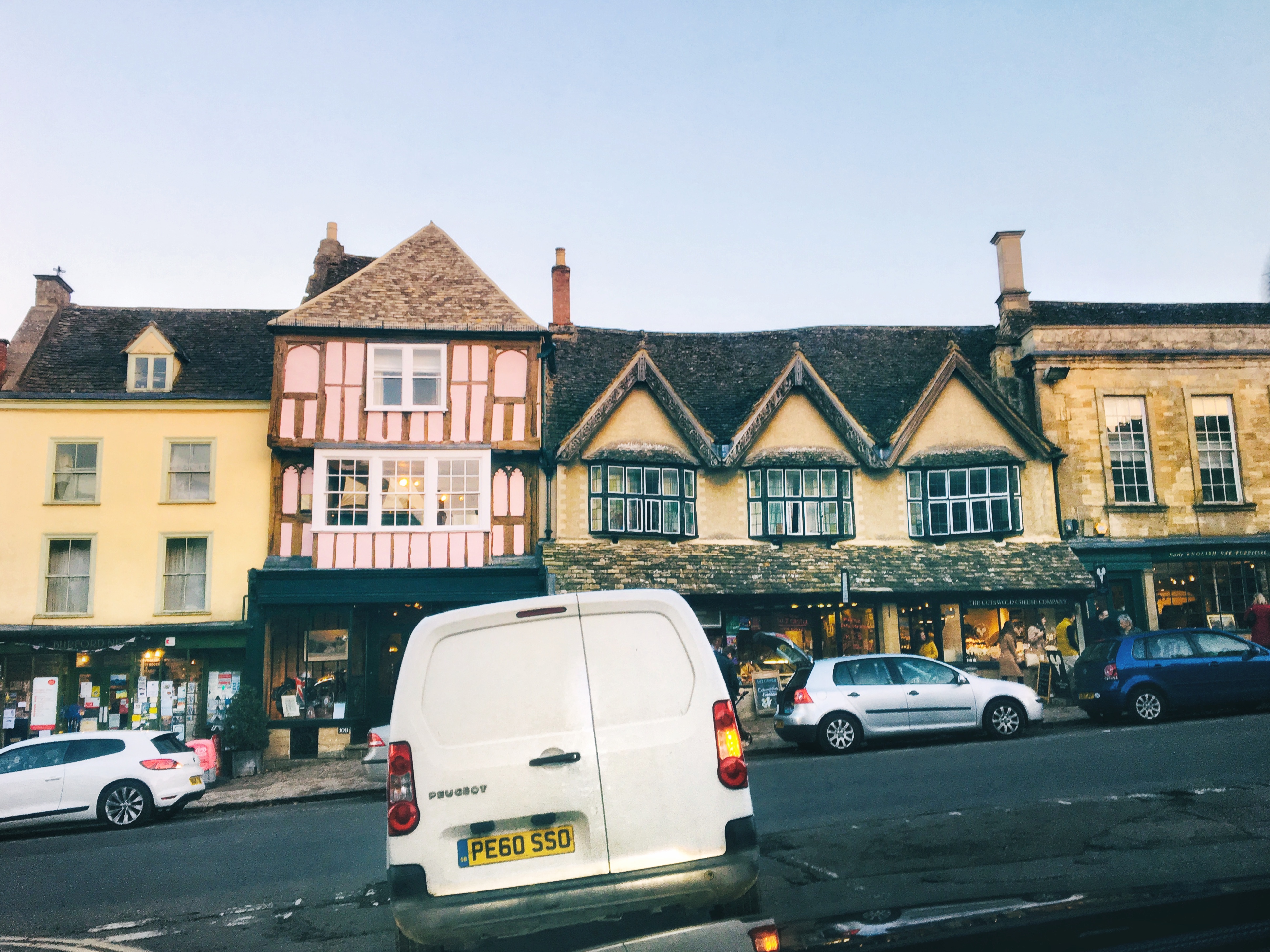
As I sift through the hundreds of photos from our most recent trip, I can’t help but remember how often I mentally constructed a shot only to realize a white van sat inside the frame. Occasionally it’s grey, or less often, black, but a van is a van when it’s taking up space in front of the perfect architectural contrast of old and new that I find so striking. It’s what disrupts the vanishing point of a village lane, or an interesting streetscape. It’s the marshmallow like box of a vehicle often emblazoned with neon logos, dot coms, and slogans–all necessary, of course, if one is in need of the services provided. Who am I to suggest they shouldn’t be where they’re supposed to be, attending to clients’ needs or headed from one job to the next?
continue -
Junior High
The bus stop was around the corner, across a street, then down half the length of Broadview, a street that ran parallel to our street. It was the back street–the one that bordered the field with the storm drain. The field that we heard someday would become a freeway. I felt like I was in a completely different neighborhood even though all the houses were exactly like those on Elkelton. Diamond paned windows still dark in the early morning light, cars still in driveways, I walked to the corner where I had been told the bus would be. No one was there.
(more…) -
The television effect
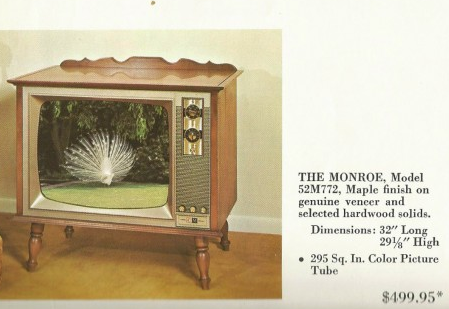
One of the many new aspects of our life at the house on Elkelton was a color television. The Curtis Mathes set was Colonial in style and made of maple. It was a big box of a thing that sat on four decorative legs about six inches off the floor. To me, it resembled a cartoon pig with legs too small to support its body. In 1968, it was the Cadillac of color televisions. The last time we had a television in the house, it was nothing like this. The old black and white cube of a set with the simulated wood finish had followed us to Spain and back and was sitting in the garage looking every bit the oddity it was. After begging our parents to stop at every motel that advertised a color TV on our drive across the country, the idea of seeing a large screened wonder sitting in our own living room was almost magical.
Years of playing outside with the neighborhood pack on the Navy base quickly transitioned into TV Guide scheduled reruns on school afternoons and late weekend nights. Sliding down grassy banks on flattened cardboard boxes, drawing on the street in front of our house with roadside chalk, playing jacks, and roller skating were replaced by the canned laughter of Bewitched, That Girl, and The Beverly Hillbillies. Gilligan’s Island practically played on loop– ridiculous considering the show only ran two years on prime time. With only three channels to choose from, our viewing schedule was pretty much set.
We watched so much television, I still remember the words and melodies of some of the commercial ditties–like Van de Kamp’s Baked Beans. Thanks to the wonder of the internet, you can go back in time to enjoy this gem my brain has safely stored on its Rolodex.
“All the little things that make you smile and glow!” Or as my stepfather Leo referred to beans when they were on the dinner menu, “Hundreds of magical things.”
We rarely if ever had the ability to make requests of my mom when the time came for the every other week grocery shop at the Navy commissary. But now, we were connoisseurs of whatever brand caught our attention thanks to television. No longer were we locked into the Prell, Crest, Zest household we’d been for as long as I could remember. I can still smell the Pledge furniture polish we used when it was my turn to clean the living room, or the Ivory dishwashing liquid when it was my turn to do the dinner dishes. Soon, Palmolive, Irish Spring, and the Brawny paper towels that only Leo was allowed to use made their way into our lives. Where as before, we walked home from school for lunch each day, now we had our very own supply of Twinkies, Ding Dongs, and Ruffles potato chips or Fritos to stuff into baggies each day. It’s no wonder my weight began to creep up. By the time I was in the 8th grade, my lean body had grown to 130 lbs.
The irony of having a new color television is that I discovered the comfort of old black and white movies. I’d scan the TV Guide for them, marking the listing with a star to make it known I had dibs on the time slot. I was a movie fan in general because the theater and drive-in on the base were free and my parents treated us regularly. But this was different. Other than the Charlie Chan movies that aired on Sunday mornings after Mass which we watched together while making burgers (yes, you read that correctly–burgers for breakfast), I was the only one who seemed to be interested. I soon found my quiet time with Hedy Lamarr and Esther Williams. I fell in love with Robert Young and Cary Grant. Carole Lombard, Lauren Bacall, and Loretta Young all left me start struck. Movies like Mrs. Miniver, The Ghost and Mrs. Muir, and It’s a Wonderful Life became favorites I to watch to this day when I happen upon one of them and feel the need for nostalgia. Musicals and romance comedies in particular became the perfect escape from the rapidly approaching wool suit of adolescence.

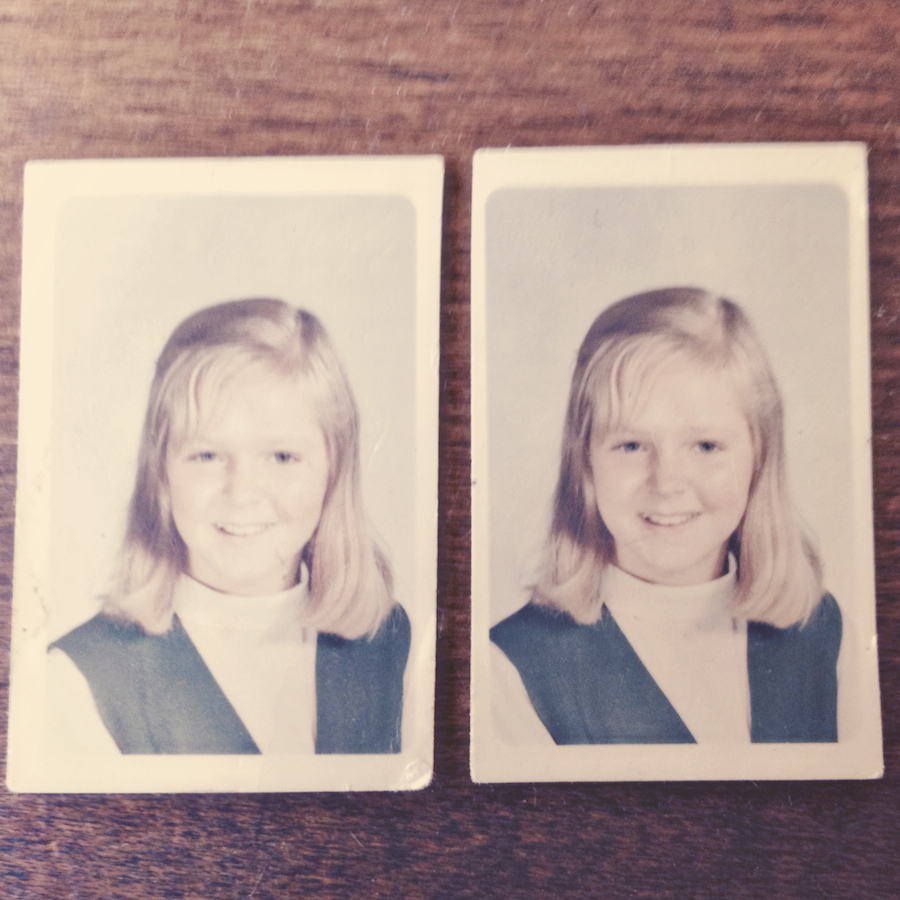
7th Grade Me And then there was the news. It would have been impossible not to be aware of world events considering we had lived on a Navy base positioned at the mouth of the Mediterranean during the Vietnam War. But the base was a relatively small community and the US thousands of miles away. Still, we knew how unpopular the war was and of the protests taking place at home. Of the assassinations of Dr. Martin Luther King Jr. and Senator Robert Kennedy within less than two months of one another, and just as we were preparing to return home. Of President Johnson deciding not to run for reelection and Richard Nixon deciding to give it one more try. Still, it was like being in a cocoon, sheltered from reality. News happened elsewhere to others.
Now, the news was in our living room, daily. Walter Cronkite reported from Vietnam in fatigues and a helmet. Choppers whooped in the background as men on the ground carried casualties on stretchers to unload them into open bays. Young men burned draft cards, women burned bras. The Soviet Union invades Czechoslovakia. Black Olympians raise their fists during a medal ceremony in Mexico City in protest of the violence and poverty Black Americans are subjected to. Astronauts circle the moon and return to Earth safely for the first time.
As much as having a television provided an escape, there was no escaping the harsh realities of life.
To be continued…
This is a draft of a memoir. I’m participating in NaNoWriMo and writing about my life in houses. It’s uncomfortable to put myself out here like this, unedited and by the seat of my pants, but I’ve got 14 days to get a good foundation down for something I’ve wanted to write for a long time. We’ll be off to England then for several weeks, and I hope to have something solid enough to work with when we return. Thanks for reading. All input is appreciated.
-
The house on Elkelton
Whether I’ve wanted to or not, I’ve hung on to certain numbers of significance in my life. They roll off my tongue when I’m playing the memory one-upmanship game with someone: 4023, the phone number assigned to our family on the Navy base in Rota, Spain; 1056, the address of the house on Navarra Lane; 3-8-55, the birthday of the boy I was supposed to marry but decided against. They’re random, just like so much of life can be.
(more…) -

Dog Days and Torpidity
August is two weeks away, but the dog days have already arrived.
It was early June when I noticed them edging into my morning rituals: I forget to step outside for that first, fresh breath of damp air; organizing the kitchen and my thoughts for the day while waiting for my coffee is hit and miss; and spending enough time on the patio to enjoy whatever is blooming happens when I get around to it. I can’t remember the last time I took a good and long early morning walk.
I can’t blame Orion and his dog star, Sirius, as they haven’t yet risen above the eastern horizon in our pre-dawn sky. I was well awake this morning and might have stepped out back to see if it was there, but didn’t. The stairs creak, I tell myself. I’ll wake my husband, the cat will want out. The dog will think it’s time to wake up. It’s easier to lie in the dark and hope sleep takes over before the sky lightens. Or before the dark thoughts creep in as they always seem to in the night, and I have to reach for my iPad for the distraction. I look up what’s in the current night sky.
Sirius won’t be visible in my corner of the world until the end of August, a time more consistent with what many relate to the dog days. Blazing heat, stagnant air, and a sense of suspended time permeate each day. That this happens when the rest of the Northern Hemisphere is beginning to enjoy cool, crisp mornings, perhaps air laced with the hint of a wood fire, or leaves beginning their yearly transformation from verdant uniformity to a riotous blaze of crimson, gold and rust, is cruel. We will have two more months of summer ahead–sometimes more. Last year a heat wave well into November had us sweltering in temperatures reaching the 90s.
If you take the time to look up “dog days”, definitions can range from “the hot, sultry period of summer between early July and early September” to “a period marked by inactivity”. Lethargy and indolence are also used to describe dog days.
Indolence: the quality or state of being indolent–slow, inactive, sluggish, torpid.
Torpid: apathetic or dormant, as a hibernating or estivating animal.
Estivate: to spend the summer, as at a specific place or in a certain activity
Those are the type of dog days I’ve been experiencing. I’m estivating. I’ve been estivating since last December. I’m at a specific place in my mind which is very different from the reality of my days. I wonder if it’s part of aging, yet I don’t feel old. I wonder if I’m bored or if I need a new hobby. I tell myself I’ll finish this project, or that, that I’ll clean the junk drawers, or redo our closet. I should call the carpet cleaners, wrap up the old china and send it away. Do something constructive. Yet I spend a lot of time staring out windows. I drift from room to room picking up and putting away with no particular purpose other than getting out of the chair I’m sitting in right now. The window is open behind the screen I’m watching letters and words appear on as I write, and a pleasant breeze causes the wind chime suspended from the curtain rod to ring occasionally. I watch people walking along the street on the other side of the wall, people on bikes out enjoying the day. I tell myself I should be out there as well.
Should I learn to speak French, or simply improve my Spanish? I could do what I once thought I might and cook my way through any of my cookbooks. Just choose one and begin. The list I made in January of bright ideas lies on my desk just to the left where I can see it. Only four of the 26 items I listed have been crossed off. To be fair, most are related to taking care of our house; it’s an ongoing job to repair or replace something in the 16 years we’ve lived here. And the four items I’ve crossed off are some of the more pleasant. I suppose I’m not motivated to check off any of the others because they’re inconvenient (replacing carpeting upstairs), they’re humdrum (touching up baseboards), or rate on the interest scale as being even with watching paint dry (going through old paper files).
When I read this back to myself, it sounds as if I’m simply lazy, but I know I’m not. Give me something interesting to do and I will engage until I drop. I’ll enjoy it, too. But if that’s the case, then why do I have so many projects unfinished? A novel in mid-restructuring. A gallery of photos to print and frame for hanging. A book of old family photos I promised to my sister and brother. I have too many interests and no deadlines and so from one day to the next, I’m left to decide for myself whether I want to do something in particular. Right now, I don’t. I’m not interested in anything for a sustained period of time. This is also evident in what I choose to read; a perfectly good book sits on my nightstand with less than twenty pages left to read. It’s been sitting for more than a month. I remember days that I’d avoid things I had to take care of just to finish a book. Photos of a recent trip sit on my external hard drive, only partially edited. This is probably more telling than anything else I’ve mentioned.
I feel suspended in time, unable to stay focused for any length. And on the odd day that I do find myself lost in a task, inevitably something interferes. Usually something insignificant. Something that distracts just long enough that I look at the clock and tell myself I should get on with my day. Go to the market. Get something to prepare for dinner.
I’ve heard that we reach peaks in our lives. There’s a tipping point, and then everything changes. I think this actually happens more than once in life and that sometimes it’s caused by circumstances we cannot control. Others seem wholly reliant upon our ability to seize the day. To make the changes we want in our lives. I’ve experienced this many times in my own life, most often making the decision to change myself. What is different now, is that the change I desire depends on another. And it is far from being a simple change. It resembles a complex array of dominoes.
And so I wait. I wait and try to sort out how to spend my time. The days pass, and I look ahead. I ignore the mantras others seem so content to embrace. “Live in the moment!” “Today is all we have!” “You only live once!”
But I’m hibernating. I’m planning for tomorrow knowing full well that it may take much longer to get here than I have to enjoy it. I count the years ahead, imagine who I’ll be, how I’ll feel. Whether I have the right to assume I have the time. That’s what stuns me.
I look out the window once more, notice the sunlight bouncing off the shiny new growth on the carrotwood trees and decide I need to get up.
I’ll clean the kitchen, go to the market, then get ready to make dinner.
Tomorrow is another day.